Make Your Own Steel Pan
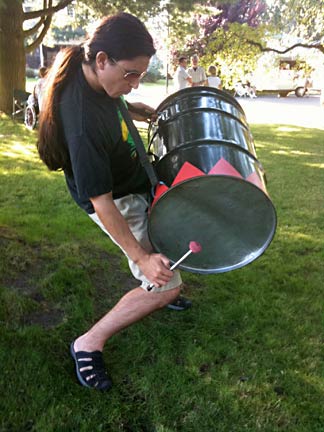
So you want to make a steel drum? After all, it's just a bunch of dents hammered onto the bottom of an old oil barrel; how hard could it be?
Well, modern pans are very difficult to craft! It takes years of training and a lot of metal-working muscle to become a professional pan-maker. But there's a type of steel drum that anyone can make, and we're going to tell you how!
It's a member of the bass pan family called the "Dudup" - a rhythm instrument made from a single barrel. The name comes from the sound the dudup makes when it is played with the right calypso rhythm! This two-note drum is one of the earliest instruments in the steel band family.
Materials Needed
Kids: Use a large coffee can or an olive oil can (the largest you can find) and a small hammer. Make sure to have a parent or teacher help you choose the right tool for your can.
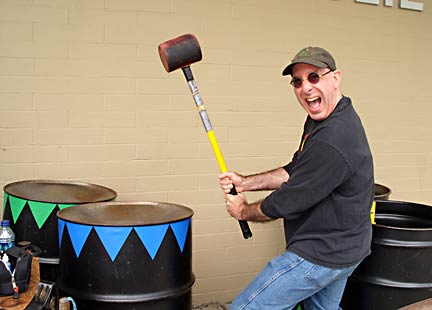
Adults: You can use a coffee can too, or for the real deal get a 25-gallon steel barrel from a junkyard or a cooperage and work on that. You will need to use a heavy ball-peen hammer to properly work the metal of the barrel. Make sure to have a kid around to help. And remember to wear ear and eye protection!
First, make your dudup stick! You'll use it to test your drum as you make it.
For Cans: Use a 6 inch piece of 1/2" dowel with rubber bands wrapped around the end.
For Barrels: You will need to glue half of a rubber bouncing ball onto the end of a wooden dowel of 1/2" diameter, about 8" long. Make a hole through the middle of the rubber ball half and use epoxy for a strong bond.
Making The Dudup
OK, now that you've got a dudup stick, your can or barrel and an appropriately-sized hammer, you are all set to begin.
Place your can or barrel so it rests firmly on a solid, flat surface. Make sure that the floor won't be ruined by pounding on it! A garage or an outdoor work area is usually best for this kind of thing.
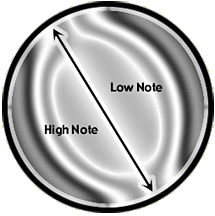
Draw a line with chalk or pen just slightly off center across the top of the can or barrel, dividing the round area into two slightly different sizes, as per our handy diagram.
Use a hammer of an appropriate size to pound up and down the line you have drawn, working the surface of the drum down gradually. Don't hit too hard! It might take a while, but soon your hammering will make a "valley" along the line. This "valley"" stretches the two areas tightly and makes them resonant.
You may have to hammer with different amounts of strength on certain areas depending on the material of your drum. Don't rush it, or you will poke a hole in your metal and ruin the drum! Remember to keep testing the two areas with your playing stick as you work to get an idea of how the drum is taking shape.
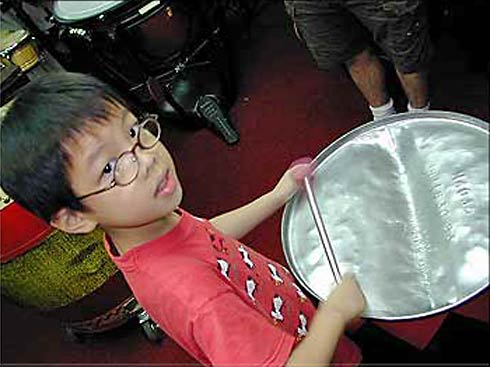
Soon the two different tones will become apparent as you create two areas under tension. If you are not having any luck, you may need to hammer UP from the inside of the barrel. This can raise the note areas and make them more taut and resonant. Keep trying!
Your Dudup is done when the two areas that make notes are ringing nicely, and are about a fourth or a fifth apart. Don't worry if it's not in tune with your piano; the Dudup is a rhythm instrument that sounds good in any key!
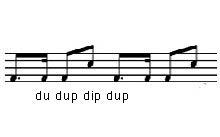
You can make shakers from cans with beans or popcorn in them. Bottles tapped (softly!) with wooden sticks and the sound of these shakers can form the basis for a great rhythm band! Play the Dudup with a "du-dup dip dup" rhythm for that authentic island beat!
- Dudup Demonstration
- click to play
-
Toucans Flash Audio Player
Panyard Soundscape : A demonstration of the Dudup rhythm instrument in a medley of other panyard percussion, steel drum tuning sounds and early steelband melodies. (Recorded by the Toucans in 1997. Steel Drum tuning sounds by Otto "Boots" Faustin.)If you'd prefer to download the MP3 file for yourself, just right-click on the song title. Remember, our music is free to enjoy, but not to re-distribute!
Brought To You By The Toucans
This original content is ©1995-2010 by the Toucans Steel Drum Band. Please represent the Toucans as the original author if you quote parts of this article elsewhere. This article may not be reprinted in full without permission.